
Shoulder Care & Internal Impingement: Fixing the Rotator Cuff
Why does my son complain of deep pain in the back or top of his shoulder only when he brings his arm all the way back to throw?
When your son says his shoulder feels completely normal until he reaches maximum "layback" (the late cocking phase of pitching), he is describing the classic presentation of internal impingement.
This isn't a structural issue like a muscle tear bone fracture. Instead, it is a mechanical space issue inside the joint capsule.
During the late cocking phase, the arm bone (humerus) must rotate backward to an extreme degree to generate velocity. If the positioning of the joint is slightly off, the tendons of the rotator cuff (specifically the supraspinatus and infraspinatus) along with the superior labrum get physically squeezed and rubbed against the edge of the shoulder socket.
At rest, or during normal daily movements, there is plenty of clearance inside the joint. But under high-velocity throwing conditions, that repetitive pinching triggers a deep, sharp ache or a severe "biting" sensation.
The trainer mentioned GIRD or a loss of internal rotation. What does this mean? And how does it happen?
GIRD stands for Glenohumeral Internal Rotation Deficit. In simple terms, it means your athlete has lost the physical ability to rotate his throwing shoulder inward.
Every single time a pitcher throws a high-intent bull pen or a live game, the massive deceleration forces pull and stretch the back of the shoulder capsule. Research from institutions like the American Sports Medicine Institute (ASMI) confirms that pitching induces an immediate, measurable loss of shoulder internal rotation and total motion that lasts for 48 to 72 hours post-outing.
The Accumulation Effect: This short-term stiffness is a normal physiological response to throwing. The danger arises when an athlete doesn't fully restore that mobility before their next throwing session. If sleep, hydration, or targeted physical therapy are neglected, that temporary tightness hardens into a permanent adaptation.
When the back of the shoulder becomes chronically tight, it physically forces the ball of the humerus to shift upward and backward inside the socket during the throwing motion. This structural shift is the exact mechanism that causes the rotator cuff to slam directly into the bone, driving chronic internal impingement.
He does his J-Band routine every single day. So why is his rotator cuff still getting irritated?
This is one of the biggest misconceptions in youth baseball today. Parents see their athlete doing a tubing or J-Band routine before every game and assume their arm care is fully taken care of.
Band routines are phenomenal for activation. They serve as a great neurological primer to wake up the muscles surrounding the shoulder blade and get blood flowing into the rotator cuff before throwing.
But activation is not the same thing as true strength building.
To protect a joint experiencing over 100 Newton-meters of torque during a pitch, the muscles need to be genuinely strong and capable of absorbing high structural loads. Light band resistance does not provide enough progressive overload to build dense, durable muscle fibers or reinforce the eccentric braking system.
If an athlete only activates the shoulder without ever building deep, positional tissue strength, the muscles quickly fatigue during a high-volume outing. Once fatigue sets in, the shoulder loses its stability, the joint mechanics break down, and the rotator cuff starts getting pinched all over again.
Can a shoulder impingement cause his throwing velocity to suddenly drop 4 to 5 mph?
Absolutely. In fact, a sudden, unexplained drop in velocity is often the very first warning sign that internal impingement is happening.
The human body is an incredibly smart, highly protective system. Its primary directive is simple: avoid pain at all costs.
When the brain senses that the rotator cuff is about to get pinched at peak layback, it triggers a protective neurological inhibition. To prevent further structural damage to the joint, your body will automatically alter throwing mechanics, bypass the normal kinetic chain, or limit muscle firing efficiency.
Your son isn't intentionally throwing slower; his nervous system is actively pulling the emergency brake on his pitching to avoid pain. Trying to force him to throw through this deficit will only break down his mechanics further, leading to compensation injuries downstream in the elbow or lower back.
What does an actual shoulder care rehab program look like at Integrated Performance versus just resting it?
Telling a competitive pitcher to "just rest it for two weeks and take some ibuprofen" is an outdated, failed approach to sports medicine. Rest makes the pain go away temporarily because the athlete isn't pinching the tissue anymore, but it does absolutely nothing to fix the underlying mobility restrictions or structural weakness. The moment they step back on the rubber, the pain returns.
At Integrated Performance, our clinical rehab programs are dynamic and built specifically around the athlete’s active throwing calendar to ensure they train smarter and harder without fatiguing the system.
|
Training Phase |
Ideal Timing |
Primary Focus & Exercise Type |
Clinical Purpose |
|
Arm Restoration |
Day of Pitching (Post-Throw) |
High-load eccentric exercises (e.g., controlled deceleration band paths) |
Restores post-throw range of motion, eliminates trigger points, and builds high-level tissue durability. |
|
Arm Development |
2 Days Away From Pitching |
Heavy, isolated strength work (Quadruped I's, Y's, T's with a locked-in core) |
Targets deep rotator cuff and periscapular strength under progressive overload when the arm has adequate recovery time. |
|
Isometrics & Primers |
Day Before Pitching |
Non-fatiguing end-range holds (floor presses at full shoulder flexion at 75% effort) |
Enhances structural strength at the exact joint angles where mechanics break down without fatiguing the muscle before a game. |
Get Off the Bench. Fix the Root Cause.
Don't let a minor mechanical pinching issue turn into a season-ending structural injury. If your athlete is struggling to maintain his velocity or constantly complaining about that deep, frustrating ache in the back of his shoulder during long toss, it’s time to stop guessing.
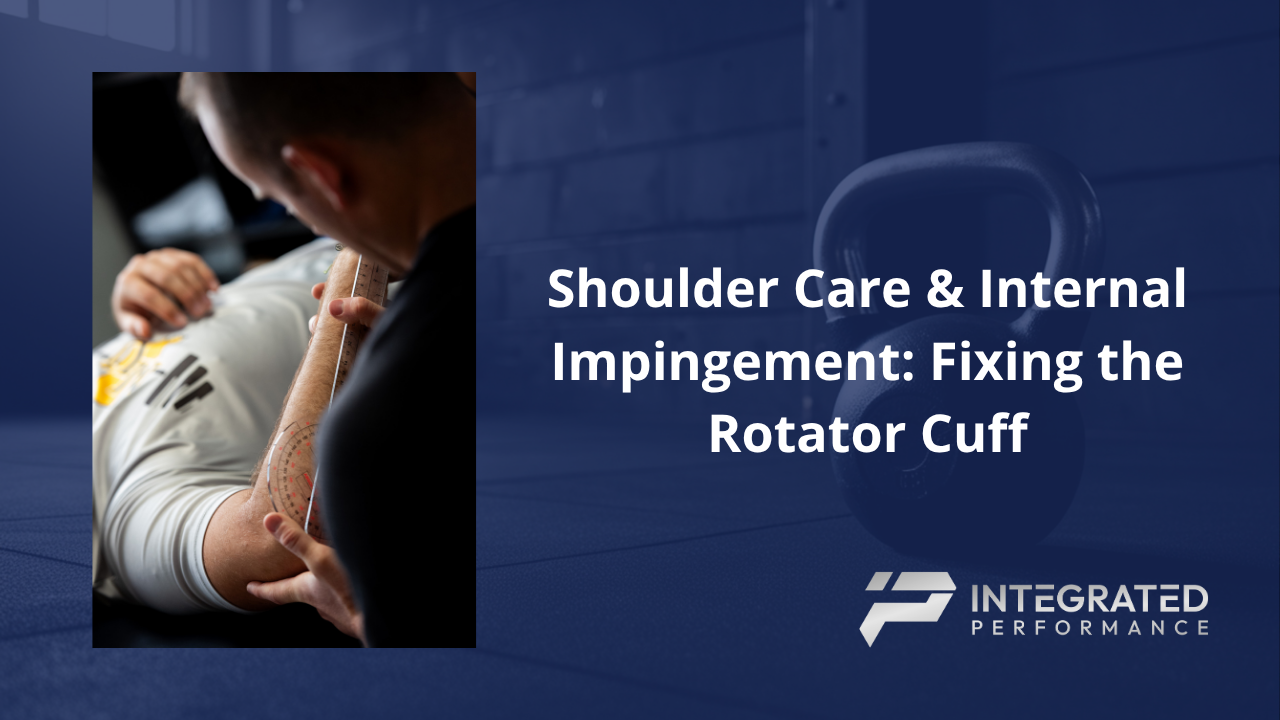
At Integrated Performance, operating directly out of the Indiana Baseball Academy in Westfield, we specialize in diagnosing and correcting the exact kinetic chain deficits that hold athletes back. We will evaluate his total shoulder arc of motion, measure his internal rotation, and build a precise, customized rehab track that gets him back to dominating the strike zone safely.
Let's get his arm right. Give us a call at 812-686-9550 or Schedule an Elbow & Kinetic Chain Evaluation Today to keep him healthy, durable, and performing at his absolute highest level.
Want to Make Sure You Do Not Miss a Post?
Enter your information for FREE newsletters, content, and special offers from Integrated Performance
We will not SPAM (unsub at any time)
