
Flexor-Pronator Strain vs. UCL Strain: Does My Son Have Tommy John or a Muscle Strain?
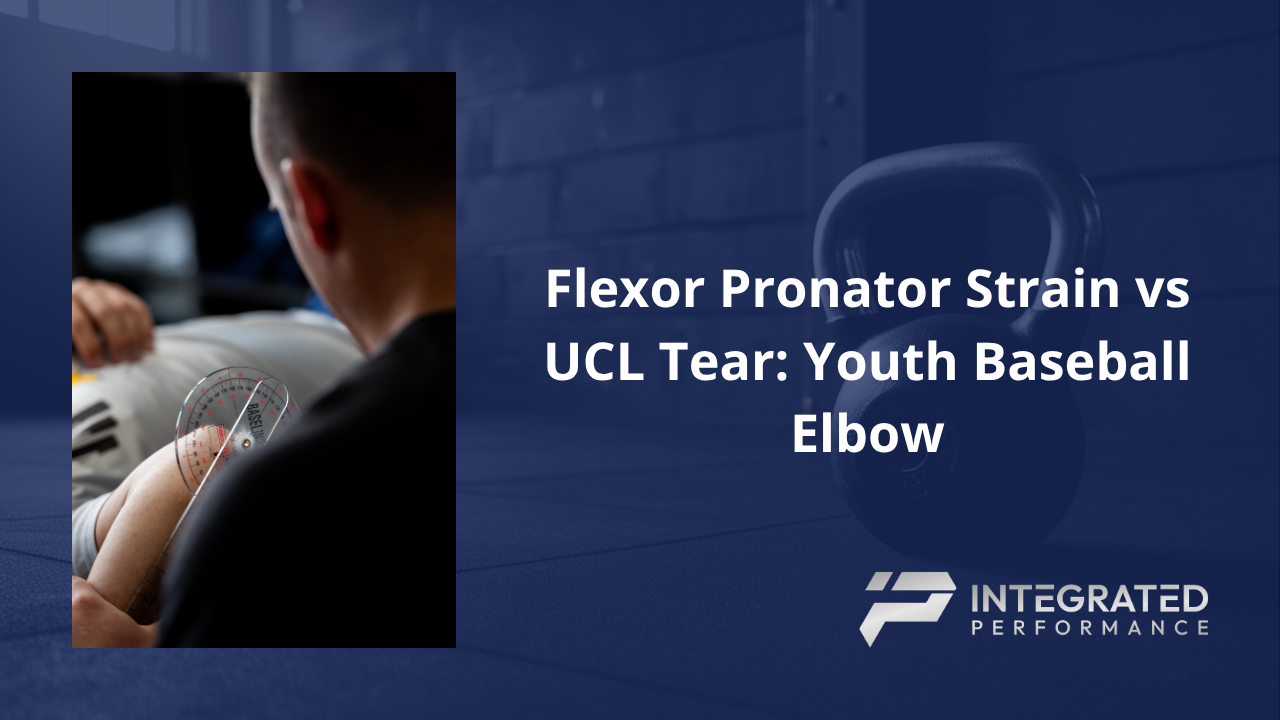
If your son just wrapped up a heavy weekend slate at Grand Park Sports Campus in Westfield or pitched through a high-stakes local conference game in Carmel, Noblesville, or Zionsville, and is now grabbing the inside of his elbow, your mind probably jumps straight to the worst-case scenario: a torn Ulnar Collateral Ligament (UCL) and Tommy John surgery.
As a physical therapist who has managed elbow injuries at both the Major League Baseball level with the Minnesota Twins and with local high school and collegiate throwers, I see this exact panic every single week.
The inner elbow is complex. Very often, what feels like a catastrophic ligament tear is actually a flexor-pronator strain or tendinopathy. Below, I am answering the 5 most common questions parents and athletes ask when dealing with medial elbow pain, breaking down the exact biomechanics, research, and return-to-pitching protocols we use at Integrated Performance.
My Son Was Diagnosed With a Flexor-Pronator Strain, But His Inner Elbow Hurts Right Where the UCL Is. Is This Actually Tommy John or Can It Be Both?
It is extremely easy to confuse a flexor-pronator strain with a UCL injury because of basic anatomical location.
The flexor-pronator muscle mass (specifically the pronator teres and flexor carpi ulnaris) originates directly at the medial epicondyle—sitting directly on top of the UCL. These muscles act as dynamic stabilizers for the inner elbow, working overtime to protect the underlying ligament during maximum throwing velocity.
Surface Layer → Flexor-Pronator Muscle Mass (Dynamic Stabilizer)
Deep Layer → Ulnar Collateral Ligament / UCL (Static Stabilizer)
How We Differentiate Them in the Clinic
While both cause sharp inner elbow pain, we use specific clinical stress tests to isolate the tissue:
- Flexor-Pronator Strain: Pain is triggered actively when the athlete grips an object tightly, flexes their wrist against resistance, or turns their palm down (pronation) against force. The muscle is being asked to contract, which pulls on the inflamed tendon.
- UCL (Tommy John) Strain: Pain is triggered passively by valgus stress—the opening force placed on the inner elbow joint during the late cocking and acceleration phases of the pitching motion.
Can it be both? Absolutely. When the flexor-pronator muscle mass gets fatigued or strained, it loses its ability to dynamically absorb force. That forces the raw valgus torque directly onto the UCL, making a dynamic muscle issue evolve into a static ligament strain. In our clinic, we perform specific testing—like the Moving Valgus Stress Test and Resisted Pronation Test—to know precisely which structure is compromised.
Does a Flexor-Pronator Strain Require Surgery and How Long Will My Son Be Out of Pitching?
The short answer: Over 90% of flexor-pronator strains do NOT require surgery.
For standard strains and chronic tendinopathies, conservative physical therapy is the gold standard.
The True Rehabilitation Timeline
The recovery timeline generally ranges from 3 to 4 weeks for a minor strain, up to 6 to 12 weeks for more significant tendinopathies.
The Biggest Mistake: Returning to the mound the moment daily pain disappears. Eliminating pain at rest takes a few weeks, but rebuilding the muscle's load capacity to handle 85+ mph valgus torque takes time.
Our rehab flow follows a strict clinical progression:
- Calm It Down: Eliminate acute inflammation and pain during daily activities.
- Rebuild Local Strength: Introduce resisted wrist and forearm exercises once special clinical testing is 100% pain-free.
- Eliminate the Root Cause: This may come from limitations in other body areas
- Structured Throwing On-Ramp: Transition from flat-ground throwing to long toss, mound work, and live hitters.
Why Did My Son Get a Flexor-Pronator Strain? Is It Caused by Throwing Sliders, High Pitch Counts, or Bad Mechanics?
The honest answer is: Yes to all of them. It is almost never a single pitch that causes a flexor-pronator strain—it is the cumulative effect of fatigue.
When an athlete pitches with arm fatigue, the shoulder and trunk muscles lose their ability to transfer energy efficiently through the kinetic chain. As the body tires, the elbow ends up absorbing the excess mechanical load. The flexor-pronator mass works overtime to stabilize the joint until the tissue simply redlines and tears.
What the Research Tells Us About Workload & Fatigue
The sports medicine literature proves that workload management is non-negotiable:
- Arm Fatigue: A systematic review by Salamh et al. (2020) demonstrated that pitching with self-reported arm fatigue is the single most significant risk factor for overhead shoulder and elbow injuries in adolescent pitchers.
- Pitch Counts & Overuse: Landmark data from Fleisig & Dun (2006) proved that pitching more than 8 months per year makes an adolescent 5 times more likely to sustain an arm injury, while consistently throwing more than 80 pitches in a game quadruples injury risk.
- Breaking Balls & Mechanics: Throwing high volumes of sliders or curveballs with improper forearm mechanics puts excessive forced supination and extension stress directly onto the flexor-pronator origin.
What Specific Physical Therapy Exercises Actually Fix a Flexor-Pronator Strain So It Doesn't Happen Again?
Fixing a flexor-pronator strain requires a two-pronged strategy: local tissue remodeling and global kinetic chain corrections.
1. Local Repair: Progressive Eccentric Loading
Once acute inflammation subsides through manual therapy and edema management, we must rebuild the tendon's tensile strength.
We utilize eccentric wrist flexion and pronation drills—where the muscle lengthens under a controlled load.
2. Global Repair: Looking Beyond the Elbow
Why did the elbow overload in the first place? Because the elbow is stuck in the middle of a broken kinetic chain.
- Back Leg Ankle Mobility: Research by Shitara et al. (2021) proved that an ankle dorsiflexion deficit in the back leg is a direct, independent risk factor for shoulder and elbow injuries in baseball players. If the back ankle cannot bend properly, drive mechanics break down, forcing the arm to drag behind.
- Shoulder Rotational Strength: Implementing targeted shoulder arm care programs has been proven to reduce pitching-related arm injuries by over 50% (Matsel et al., 2021).
How Do We Know When It's Truly Safe for Them to Start Pitching at 100% Velocity Again?
You never jump straight from the clinic table to 100% mound effort. Being "cleared to play" by a doctor just means the tissue is healed at rest; being ready to pitch means the whole body can handle maximum intent.
We progress athletes through a strict, multi-stage Interval Throwing Program (ITP):
Stage 1 - Flat Ground (45–60 ft) → Sub-maximal effort, building volume
Stage 2 - Long Toss (120+ ft) → Stress matches mound torque
Stage 3 - Mound & Bullpen Work → Rebuilding slope mechanics
Stage 4 - Live Batters / Games → Handling 100% intent & adrenaline
The Return-to-Mound Milestones
- The 120-Foot Gate: Research shows that long-toss distances reaching 120 feet generate elbow valgus torque equivalent to throwing off a competitive mound. If an athlete cannot clear 120 feet completely pain-free, they are not ready for mound work.
- Managing Perceived Effort: Studies by Melugin et al. (2019) show that a pitcher's perceived throwing effort rarely matches their actual measured effort. We monitor radar metrics and volume strictly so athletes don't accidentally over-stress the healing tissue during early ramp-up phases.
- The Live Batter Adrenaline Spike: Facing live hitters naturally increases velocity by 3 to 4 mph due to adrenaline. We account for this intensity spike before clearing an athlete for full tournament play at Grand Park.
Get a Specialized Baseball Elbow Evaluation in Westfield & Carmel
If your son is dealing with lingering inner elbow pain, don't wait for a mild strain to become a season-ending UCL tear.
At Integrated Performance, our clinical physical therapy team brings Major League Baseball rehabilitation standards directly to athletes in Westfield, Carmel, Noblesville, and Zionsville. We evaluate total-body biomechanics—from back leg ankle dorsiflexion to lead leg block efficiency and elbow load tolerance—so your athlete can return to the mound stronger, faster, and bulletproof.
Schedule a Comprehensive Baseball Elbow Evaluation Today
Train smarter. Recover harder. Let's go.
Want to Make Sure You Do Not Miss a Post?
Enter your information for FREE newsletters, content, and special offers from Integrated Performance
We will not SPAM (unsub at any time)
