
The Parents' Guide to Growth Plate Stress and Little League Elbow in Middle School and High School Pitchers
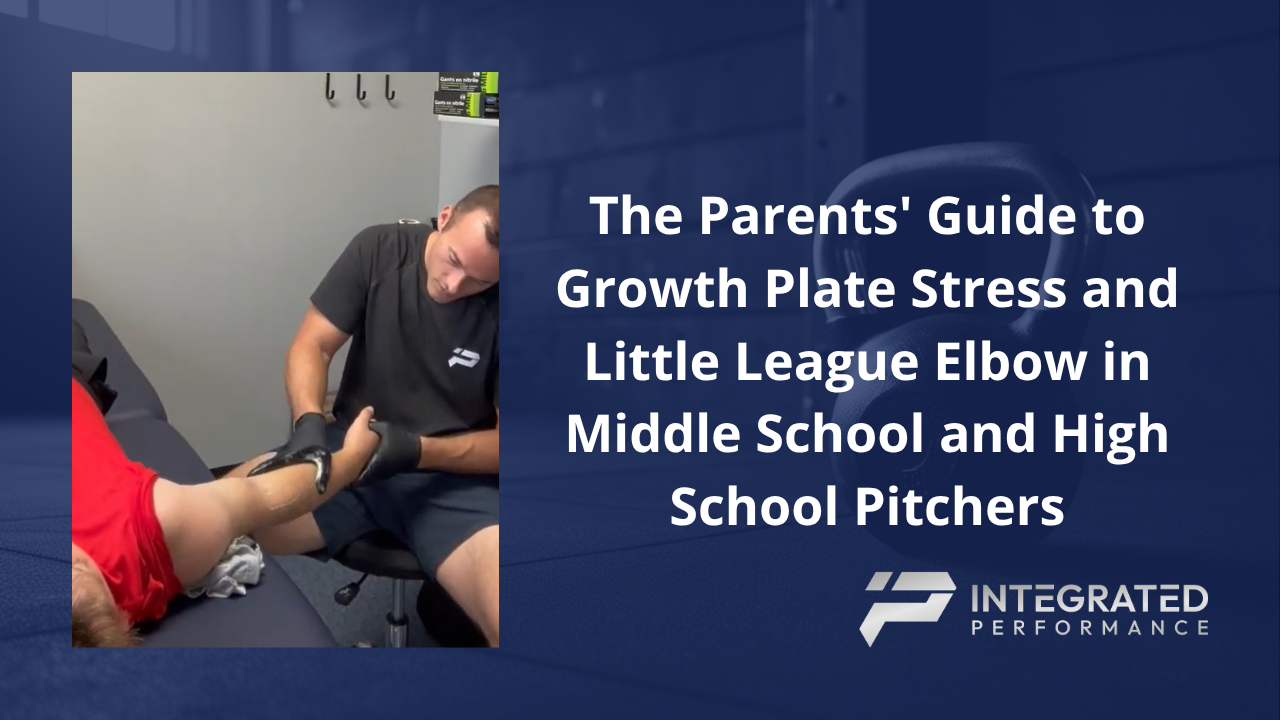
Can High School Freshmen or Sophomores Still Get Little League Elbow, or Is It Just a Youth Injury?
Absolutely, they can. Don't let the name fool you. While people think "Little League Elbow" is strictly for 11-year-olds, the medical reality is that a pitcher's growth plates don't fully fuse until they are anywhere between 15 to 17 years old.
If your freshman or sophomore is hitting a massive growth spurt while playing for their high school programs, those open growth plates are highly vulnerable. Before full skeletal maturity, the immature bone is actually the weakest link in the system—it is significantly weaker than the surrounding ligaments and muscles. This means the bone will often yield or become injured long before a ligament like the UCL fails. Spikes in throwing volume without an adequate on-ramp—especially pitching more than 8 months a year or exceeding critical inning thresholds—dramatically accelerate this structural stress.
Medial Epicondyle Apophysitis vs. UCL Strain: How Can a Parent Tell the Difference?
Without an expert clinical assessment or advanced imaging, telling them apart is tough, but here is how we tease it out in the clinic using exact anatomy and presentation.
- The Age and Bone Factor: If your athlete is still growing and complains of medial elbow pain (pain on the inside of the elbow), there’s a good chance it’s a growth plate issue—clinically known as Medial Epicondyle Apophysitis.
- The Touch Test: Have your son point to the pain with one finger. If he is directly tender right on that prominent, sharp bony bump on the inside of his elbow, that’s most likely the growth plate.
- The Deep Ache: A Ulnar Collateral Ligament (UCL) Strain is typically localized about a half-inch lower and feels like a deep, dull, aching pain inside the joint rather than a sharp, surface-level pain on the bone itself.
Ignoring that sharp bony pain can quickly lead to severe secondary issues like Valgus Extension Overload (check out our blog on that here) or Internal Impingement as their mechanics break down to protect the injury.
What Is an Elbow Avulsion Fracture in Baseball, and Can Ignoring Soreness Cause It?
An elbow avulsion fracture isn’t a good scenario that happens when an athlete ignores minor pain and keeps throwing.
When a young pitcher develops micro-tears and structural stress fractures in the growth plate but continues to push through it, the repetitive, violent pull of the forearm flexor-pronator muscles becomes too much for the growth plate to handle. Once the bone can’t handle it anymore, a piece of it actually breaks off a little.
Research proves that pitching with arm fatigue is the single most significant risk factor for catastrophic shoulder and elbow injuries. What started as a little "twinge" during a tournament game can instantly turn into a season-ending structural failure if you ignore the body's warning signs.
Why Does My Son’s Elbow Keep Hurting Even After 3 to 4 Weeks of Total Rest?
This drives parents crazy, but here’s the thing: Rest alone is not rehabilitation.
If your son has an actual growth plate stress fracture, it takes far longer than three to four weeks of total rest to structurally remodel and heal the bone. But let’s say it was just localized inflammation or a mild flexor strain, and the pain completely went away with rest—only to flare right back up the minute he steps back on the bump. Why does that happen? Because you rested the tissue, but you didn't fix the kinetic chain that caused the injury in the first place.
Why the kinetic chain matters: If a pitcher has limited shoulder flexion (the ability to reach straight overhead), his biomechanics will force a lateral trunk lean to get the ball up. This completely alters his arm slot and magnifies the valgus torque on his elbow.
Peer-reviewed research from Shitara, et al. show that energy leaks further down the chain—like limitations in back-leg ankle mobility—force the upper body to overcompensate. If you don’t fix the ankle, shoulder, hips, or core, the elbow will always pay the price the second intent goes up.
What Does an Effective Adolescent Growth Plate Rehab Protocol Look Like?
A bulletproof adolescent growth plate rehab protocol doesn't just focus on the elbow—it focuses on restoring the entire athlete and preparing them safely for a true return to sport. Here is what our phased physical therapy progression looks like:
- Phase 1: Shutdown from throwing: We completely pause all throwing activities until the athlete is 100% pain-free during daily life and localized clinical palpation. Depending on the severity of the stress fracture, this typically takes a minimum of 6 weeks.
- Phase 2: Total-Body Optimization: While the arm rests, we get to work on the root causes. We attack total-body deficiencies by building foundational shoulder external rotator strength, maximizing hip and thoracic mobility, and locking in core stability to eliminate energy leaks.
- Phase 3: Structured Progressive On-Ramp: We never just hand a ball back to a kid and tell them to go play. We implement a strict, multi-week throwing progression where volume always precedes intensity. We build up the number of throws at controlled, low-intent distances (like 60ft to 90ft) before we let them throw max-effort or face live hitters, where stress naturally spikes.
For severe growth plate injuries, the standard of clinical care may mean zero competitive pitching for that entire calendar year, transitioning them safely to fielding work to protect their long-term athletic career.
Train Smarter, Recover Harder
Don't let a manageable growth plate issue turn into a season ending injury. If your young athlete is struggling with inside elbow pain after throwing at Grand Park or practicing in Westfield, Carmel, Noblesville, or Zionsville, let’s get it checked out immediately. At Integrated Performance, we don't just wait for things to clear up—we actively rehab the root cause so your athlete can return to sport stronger, safer, and ready to dominate every single rep. Let's go.
Let's get his arm right. Give us a call at 812-686-9550 or Schedule an Elbow & Kinetic Chain Evaluation Today to keep him healthy, durable, and performing at his absolute highest level.
Want to Make Sure You Do Not Miss a Post?
Enter your information for FREE newsletters, content, and special offers from Integrated Performance
We will not SPAM (unsub at any time)
