
Pitcher Lat & Teres Major Strains: Rehab & Recovery Guide
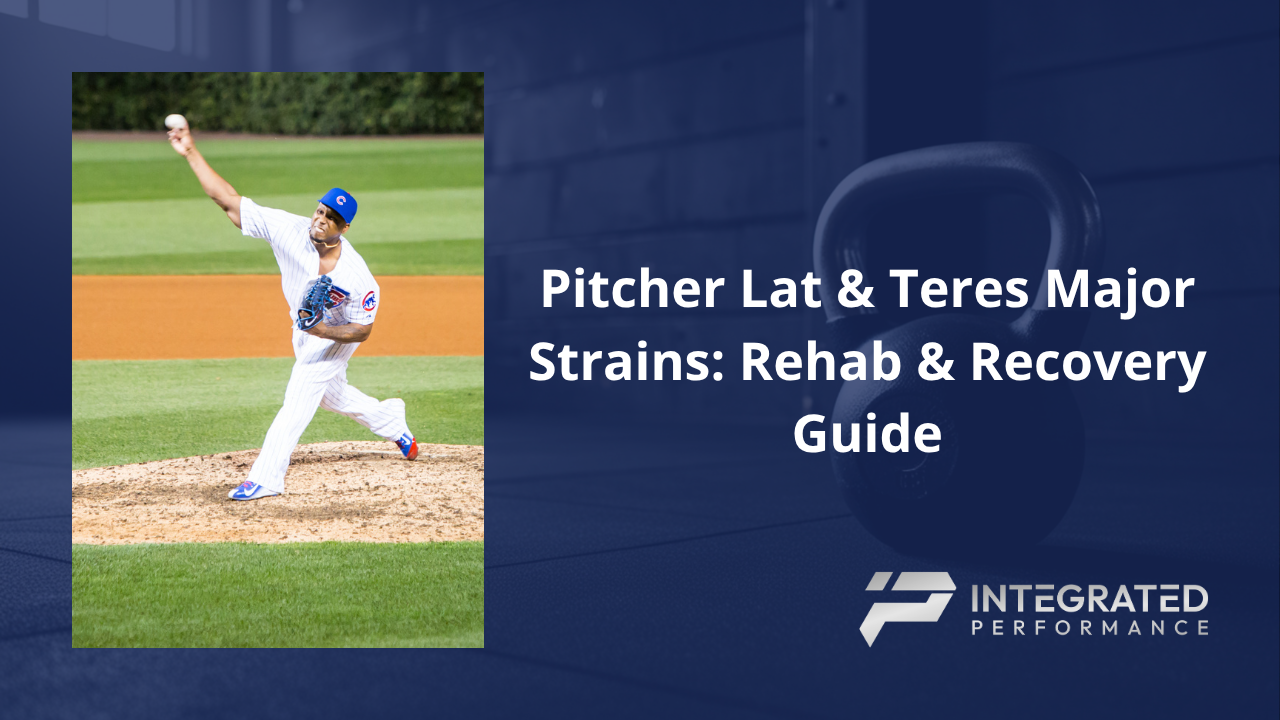
I often get questions after a high-intent pitching session about whether an athlete is dealing with normal soreness or a legitimate injury . If you are feeling a sharp pain underneath your armpit and down your back after throwing, you might be dealing with a latissimus dorsi or teres major strain. We need to tease out the difference between normal muscle fullness and a true injury so we can keep you developing and performing on the field .
Why Does It Hurt Under My Armpit and Down My Back?
There are a couple of muscles that attach on the backside of your shoulder, run into your armpit, and anchor all the way down to the back of your hip. The latissimus dorsi is the major one. It acts as a massive braking system for your arm.
Pitching is a high-velocity movement, but we also have to stop the arm after the ball is released. The lat and teres major absorb a massive amount of eccentric forces to decelerate your arm. When these muscles can't handle those extreme forces, they get strained, leading to that sharp pain in your armpit or down your back.
Is a Lat Strain a Shoulder Injury or a Back Injury?
Clinically, we classify this as a posterior shoulder injury. Even though the muscle belly covers a vast area of your back and anchors to the posterior side of your hip, its main mechanical job is controlling the humerus (your shoulder joint).
When you strain this muscle, you create a massive energy leak. This leak prevents you from transferring energy effectively through your core. Ultimately, it makes it really hard to decelerate and stop your arm safely after a high-intent throw.
Can Weighted Balls Cause a Teres Major or Lat Tear?
The answer is pretty clear on this one. Max-intent velocity training, like weighted ball pulldowns, drastically increases your shoulder layback and forearm speed. Our shoulders can reach arm speeds of over 7,000 degrees per second!
Throwing overweighted at 100% intent demands a massive eccentric effort from the lat and teres major to slow the arm down. If you haven't adapted those muscles to handle that deceleration through a structured program, they are going to tear.
How Long Does Recovery Take?
-
Grade 1 Strain: This is a very mild micro-tear. It typically takes between 3 to 6 weeks of structured physical therapy to get you back to throwing with high intent.
-
Grade 2 Strain: This is a partial tear and requires about 8 to 14 weeks of recovery.
-
Full Return to Game Pitching: Clinical studies on professional and collegiate throwers show that non-operative lat and teres major strains average roughly 99 to 100 days for a full return to the mound. (e.g., Mehdi et al., 2016).
Typically, the pain disappears by week three or four. However, the relapse rate is over 20% because pitchers rush back before the tissue remodeling is complete. We have to ensure a gradual return-to-throw progression so the tissue can handle high-velocity forces again.
The Criteria-Based Return-to-Throwing Protocol
Our clinical return-to-throwing protocol follows a systematic progression :
-
Symptom Resolution & Local Capacity: We eliminate pain on the treatment table and restore full lat length (mobility) and local muscle strength .
-
Dynamic Deceleration: We introduce high-speed plyometric progressions and eccentric loading drills, such as ball catches, to recondition the braking system .
-
Stability & Movement Testing: We test upper quarter stability using dynamic movement screens and the Upper Quarter Y-Balance Test to confirm total shoulder and core stability .
-
Interval Throwing Program (ITP): Throwing begins on flat ground at 45 to 60 feet, gradually building volume and distance through long toss and structured flat grounds .
-
Mound Progression: Once flat-ground volume and distance markers are completed without pain or compensation, the pitcher earns the right to step back onto the mound .
Stop Guessing. Build a Durable Throwing Arm.
If your player is struggling with shoulder pain after pitching at Grand Park, competing in high school conference play, or grinding through travel ball across Westfield, Carmel, Noblesville, or Zionsville, don't wait for a complete shutdown.
At Integrated Performance, our Physical Therapists don't just hand you a bag of ice and tell you to stop playing. We evaluate the entire athlete—from hip mobility and core strength to shoulder mechanics—to resolve pain, rebuild the kinetic chain, and guide you through an objective, step-by-step return-to-throwing program.
Is your athlete dealing with lingering pain?
Click here to schedule a comprehensive physical therapy evaluation with our sports PT team today!
Want to Make Sure You Do Not Miss a Post?
Enter your information for FREE newsletters, content, and special offers from Integrated Performance
We will not SPAM (unsub at any time)
