
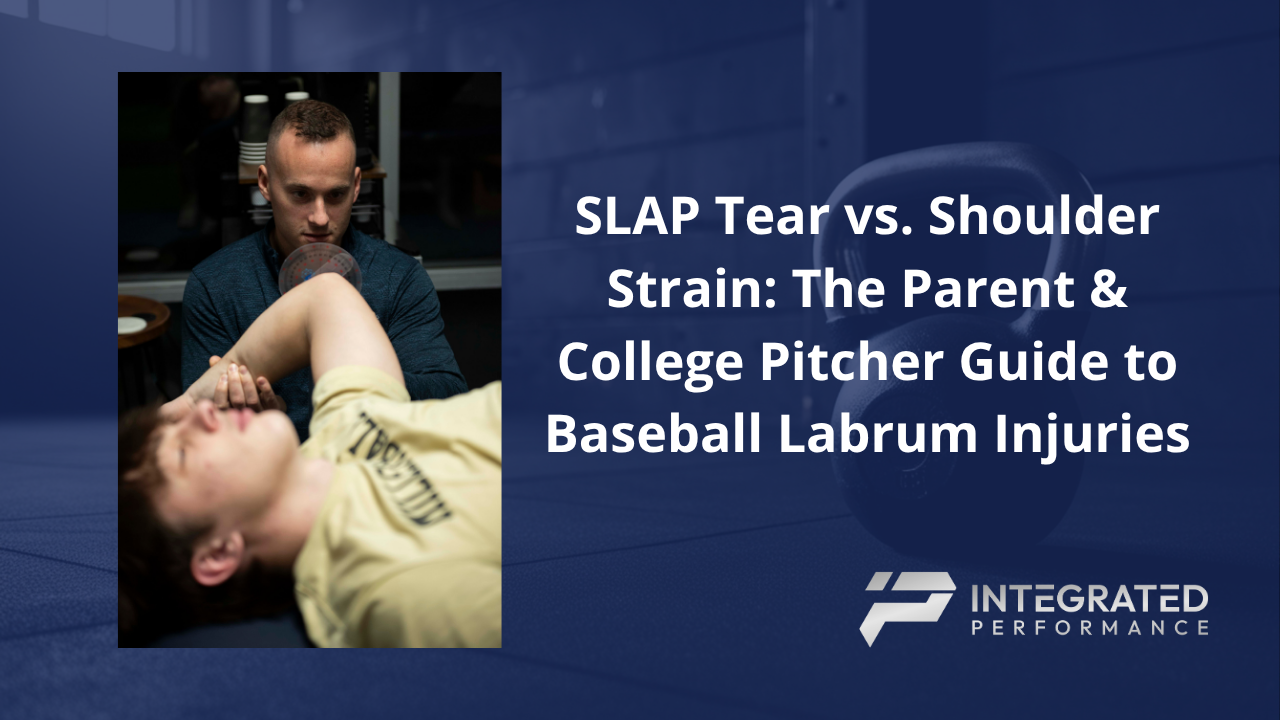
SLAP Tear vs. Shoulder Strain: The Parent & College Pitcher Guide to Baseball Labrum Injuries
What Does a Labrum Tear in a Pitcher Feel Like, and How Is It Different Than a Rotator Cuff Strain?
Telling the difference between a SLAP (Superior Labrum Anterior to Posterior) tear and a rotator cuff strain comes down to four major factors: pain location, sensation, and impact on velocity.
1. Pain Location
- SLAP (Labrum) Tear: The pain feels deep inside the joint. Athletes describe it as being buried right in the middle of the shoulder socket, and they can’t point to it with just one finger.
- Rotator Cuff Strain: The pain is more superficial and localized to the top or backside of the shoulder. The athlete can usually press directly on the outside of the shoulder and pinpoint the sore muscle.
2. Sensation & Mechanical Red Flags
- SLAP Tear: Causes mechanical symptoms like popping, catching, or clicking at peak layback. It is often accompanied by a sudden "dead arm" sensation where the arm feels completely lifeless, heavy, and impossible to lift.
- Rotator Cuff Strain: Typically presents as a dull, heavy ache or burning fatigue during and after pitching. It builds up more chronically over a game or season rather than striking as a sudden, sharp mechanical block.
3. Pitching Velocity & Command
- SLAP Tear: Triggers an immediate, sharp velocity crash. The pitcher completely loses command of their release point because the shoulder socket loses its stability.
- Rotator Cuff Strain: Leads to a gradual onset of weakness and soreness. Velocity slowly trickles down as muscle fatigue sets in, rather than dropping off a cliff in a single pitch.
Can a High School or College Pitcher Return to Throwing 90+ MPH Without SLAP Tear Surgery?
Yes, absolutely. Modern sports physical therapy and orthopedic research show that non-surgical treatment is widely considered the first line of defense for high school, collegiate, and professional pitchers with SLAP tears.
For years, the immediate reaction to a labrum tear was surgery. However, clinical outcomes have flipped that narrative. Research reveals that non-operative rehabilitation programs successfully return 50% to 70% of competitive baseball players back to full competition without ever touching a scalpel.
The Surgical Reality: Post-surgical return-to-play rates for overhead throwers undergoing SLAP repair are notoriously low, often resulting in a permanent loss of velocity. Pitchers actually have a statistically higher chance of returning to their previous level of play through targeted, non-surgical physical therapy than through surgery.
To regain velocity without surgery, you cannot treat the shoulder in isolation. You must treat the body as an entire kinetic chain. That means optimizing how the shoulder blade (scapula) moves along the ribcage, restoring thoracic spine rotation, and driving power up from the lower body through the hips and core. Research proves that addressing total-body stability—such as fixing deficiencies in single-leg balance and hip internal rotation—is critical because decreased hip rotation directly increases the risk of upper extremity kinetic chain injuries.
Why Does My Shoulder Catch or Click at the Top of My Throwing Motion?
The labrum is a ring of tough, fibrous cartilage that surrounds the shoulder socket, acting like a rubber gasket to deepen the joint and keep the arm bone (humerus) centered.
When a pitcher develops a SLAP tear, that cartilage gasket gets frayed or pulled away from the bone. During the late cocking phase of pitching—when the arm reaches extreme external rotation (layback)—the head of the humerus glides across the socket.
If there is a tear, a loose flap of cartilage can peel back and get physically pinched between the arm bone and the socket. That physical interference is the exact catching, clicking, or popping sensation an athlete feels at peak layback. Furthermore, research shows that a loss of total rotational arc or limited shoulder flexibility places abnormal shearing forces across the labrum, accelerating this mechanical wear-and-tear.
What Is the Actual Timeline and Success Rate for Non-Operative Baseball Labrum Physical Therapy?
Non-surgical physical therapy for a torn labrum is not a quick 2-week fix—it requires a committed, structured progression. A typical protocol spans 4 to 6 months total.
The 1:1 Return to Pitching Rule
A general rule of thumb for labrum rehabilitation is that your return-to-pitching timeline mirrors your shutdown timeline.
- If it takes 8 weeks of clinical physical therapy to eliminate pain, restore full range of motion, and build periscapular strength, it will take another 8 weeks of a structured throwing program to safely build back up to mound intensity.
- If the initial shutdown phase takes 12 weeks, the throwing ramp-up will take 12 weeks.
Clinical Keys to Success
Non-operative physical therapy boasts a 50% to 70% return-to-sport success rate for pitchers. Two things we need to make sure we address for returning from a labral injury:
- Restoring Glenohumeral Internal Rotation: You must eliminate internal rotation deficits in the throwing shoulder.
- Scapulothoracic Mechanics: The shoulder blade must track smoothly along the thorax to prevent compensatory pinching inside the joint. Utilizing targeted eccentric strengthening for the rotator cuff helps stabilize the joint and reduce deep joint pain.
Where Can My Athlete Get a Comprehensive Baseball Shoulder Evaluation in Carmel & Westfield?
If your son is dealing with deep shoulder pain, a sudden loss of velocity, or mechanical clicking during his delivery, he needs an evaluation from clinicians who live and breathe high-level baseball biomechanics.
At Integrated Performance, our clinical team isn't guessing—we’ve lived it.
- Dr. Nate Denning served as a Physical Therapist in the Minnesota Twins organization, managing complex shoulder and elbow rehabilitation for professional pitchers.
- All our physical therapy team actively contributes to sports medicine research for the MLB on player health and performance.
We evaluate the total kinetic chain—from lead leg block mechanics and hip internal rotation to scapular dyskinesis and shoulder rotational strength. We don't just patch up symptoms to get a player "cleared to play"; we build durable, high-performing athletes who are ready to pitch.
Train Smarter. Recover Harder.
Don't let an ambiguous shoulder ache or a scary diagnosis derail your son's high school season or collegiate recruitment. If he is experiencing shoulder pain after pitching at Grand Park or during conference play in Westfield, Carmel, Noblesville, or Zionsville, let's get it looked at immediately.
Give us a call or hit the link below to set up a comprehensive baseball shoulder evaluation with Dr. Nate Denning and the Integrated Performance team.
Schedule a Baseball Shoulder & Kinetic Chain Evaluation Today
Want to Make Sure You Do Not Miss a Post?
Enter your information for FREE newsletters, content, and special offers from Integrated Performance
We will not SPAM (unsub at any time)
