
Playing in the Heat of Synthetic Turf: How to Adjust to Summer Heat
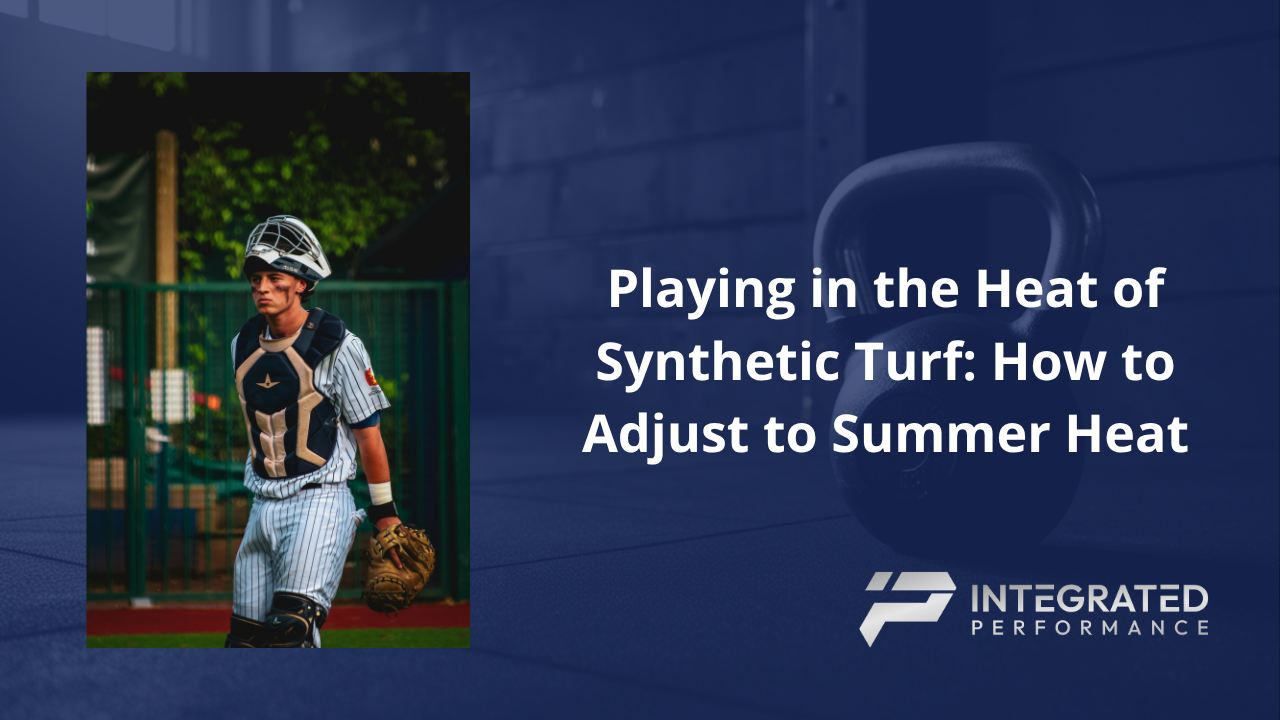
We are officially in the thick of summer ball, and the heat is getting real. If you’ve spent any time tracking weekend schedules at Grand Park in Westfield, you know what it looks like: your team is rolling through two, sometimes three games a day under a blazing June sun.
But there’s a hidden factor that most parents and players completely overlook: synthetic turf.
Playing on modern synthetic turf fields can increase ground-level temperatures significantly above the actual air temperature. It turns the diamond into a literal heater. When your son is playing a grueling double-header on that surface, his body is fighting an uphill battle against environmental stress.
By the time Sunday bracket play rolls around, most guys are running on fumes. If you want your arm to survive the summer circuit, you have to realize that playing through that level of heat requires a strategic approach to recovery. If you just wing it, you are setting yourself up to play poorly— and worse, a possible injury..
Dehydration, Sleep Debt, and the Degradation of Skills
When an athlete gets run down in the summer heat, their physical and mental skills erode simultaneously. The foundation of surviving this grind comes down to two completely free, non-negotiable pillars: hydration and sleep.
The Hydration Piece
Dehydration makes an athlete slow, sluggish, and structurally vulnerable. When your cells are dried out, your muscles lose their elasticity, forcing your tendons and ligaments to absorb toxic amounts of throwing stress.
To stay ahead of the curve, every athlete needs to hit a baseline minimum fluid intake:
Baseline Fluid Ounces = Body Weight in Lbs / 2
On hot tournament days, that is just the starting point. You have to actively replace what is lost through sweat. To calculate exact fluid replacement needs post-game, sports medicine guidelines dictate using this formula:
Fluid Replacement Needs = Body Weight Lost (lbs) x 1.5 x 16 oz
If a player steps off a turf field two pounds lighter than when they started, they need to consume an additional 48 ounces of water mixed with high-quality electrolytes within two hours to jumpstart tissue rehabilitation. Chugging plain water won't cut it; the body needs sodium and potassium to pull that moisture out of the bloodstream and back into the micro-torn muscle fibers.
The Potential Problem with On the Road Games
Summer travel ball is a blast. Being on the road and staying up late in hotels with teammates is a core memory for high school guys. But if you are consistently cheating your body out of an 8-to-10-hour sleep window during a hot weekend, your performance metrics will fall off a cliff.
Sports science research confirms that sleep deprivation directly degrades an athlete's choice reaction time and cognitive processing. In baseball terms:
- For Hitters: Sleep debt completely destroys plate discipline and pitch selection. Fatigued hitters consistently swing at more pitches outside the strike zone and strike out at a much higher rate.
- For Pitchers: Slower neurological processing compromises fastball and breaking ball command. When your brain is tired, your mechanics become erratic, and you start leaving balls over the middle of the plate.
Spotting the Redline:
As a Physical Therapist, my main priority isn’t just making an athlete throw harder—it’s keeping them out of the operating room. To prevent an injury, you have to be able to identify systemic fatigue before something snaps.
Fortunately, parents can monitor this at home with a simple, $20 digital grip strength dynamometer.
Establish a baseline grip strength. If it drops below 10% of their strength after playing or training, we need to adjust their playing/training volume. If it drops below 20%, we need to consider rest for that day.
Grip strength is an incredibly accurate window into the health of the Central Nervous System (CNS). If your son squeezes the dynamometer on a Monday morning and his grip strength has dropped by 20% or more compared to his baseline, his nervous system is completely fried.
When the nervous system is fatigued, it cannot properly recruit muscles to stabilize joints. For a baseball player, that means the forearm muscles fail to fire efficiently, shifting the immense mechanical load of throwing directly onto the Ulnar Collateral Ligament (UCL). According to the comprehensive athletic injury review by Birfer, et al, throwing with active arm fatigue is a high predictor of severe, season-ending adolescent elbow and shoulder injuries. If that grip test drops by 20%, it is a clear warning sign that playing volume needs to be throttled back.
The PT Diagnostic: Objective Shoulder Monitoring
For pitchers, we take this objective testing a step further using a digital handheld dynamometer (like an Activforce unit) to monitor targeted shoulder strength.
If a pitcher shows a 20% drop in shoulder external or internal rotation strength, they aren't suddenly "weak"—they are severely under-recovered. As highlighted in the sports medicine data by Wasserberger, et al, isolated weakness in glenohumeral external rotation directly alters throwing mechanics and drastically increases humeral rotation torque during the acceleration phase of a pitch.
When an arm hits this state of overload, traditional performance training needs to stop. This is where we pivot entirely toward clinical rehabilitation and active return-to-sport recovery protocols:
- Postural & Biomechanical Breathing: Utilizing specific, non-fatiguing diaphragmatic breathing postures to down-regulate a stressed nervous system and shift the body from a sympathetic ("fight-or-flight") state into a parasympathetic ("rest-and-recover") state.
- Individualized Correctives: Implementing non-tiring mobility drills to restore the severe loss of total shoulder arc of motion that naturally occurs after high-intent throwing weekends.
- Soft Tissue Mobilization: Using advanced manual therapy to clear out localized trigger points in the forearm, bicep, and posterior cuff before they alter the athlete's throwing track.
Shut Down the Overload Before It Shuts You Down
If your son is struggling to survive his summer tournament schedule, if his velocity is dropping by Sunday afternoon, or if he's waking up on Mondays with a deep, localized ache in his arm, his current recovery setup is failing him.
At Integrated Performance, operating right out of the Indiana Baseball Academy in Westfield, we specialize in the clinical management of competitive baseball players. We don't guess with your son's arm health. We use precise, data-driven testing to monitor his strength, assess his joint mobility, and design custom, week-by-week rehabilitation and return-to-sport blueprints that serve athletes across Westfield, Noblesville, Carmel, and Zionsville.
Don't let summer fatigue turn into a fall surgery.
Call us at 812-686-9550 or Schedule a Midweek Evaluation Today.
Want to Make Sure You Do Not Miss a Post?
Enter your information for FREE newsletters, content, and special offers from Integrated Performance
We will not SPAM (unsub at any time)
