
UCL Injury in Baseball Players: A Guide for Indianapolis Area Parents
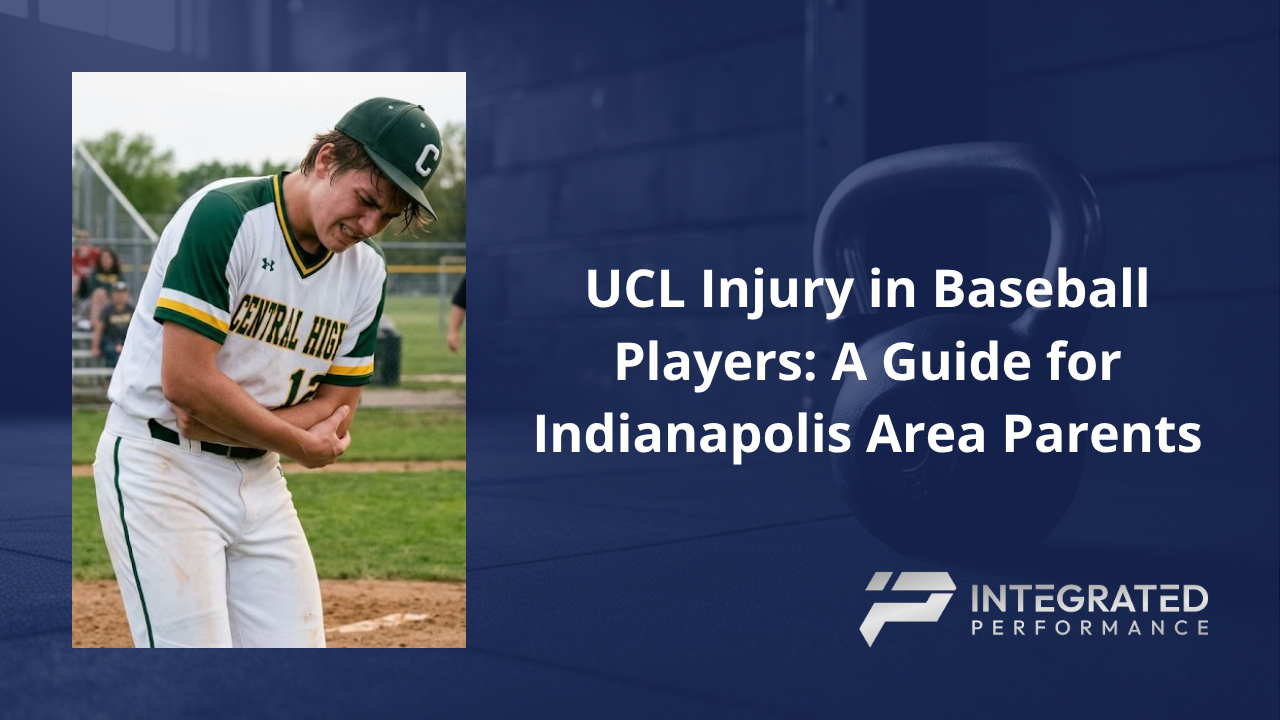
Q: What exactly is a UCL injury, and how does it happen?
The Ulnar Collateral Ligament (UCL) is a thick band of tissue on the inside part of the elbow that acts as the primary stabilizer connecting your upper arm bone (humerus) to your lower arm bone (ulna).
Think of the pitching motion as a whip. When a pitcher enters the maximum "layback" phase of throwing, the elbow is subjected to extreme valgus torque. The UCL is the emergency brake that keeps the elbow joint from pulling apart under that stress.
When an arm undergoes a sudden, unconditioned workload spike or operates under chronic, deep arm fatigue, the surrounding musculature stops absorbing shock. The force shifts entirely onto the ligament, causing a UCL strain, partial tear, or full rupture.
From a kinetic chain perspective, the elbow rarely breaks down in isolation. Biomechanical studies show that deficits elsewhere in the body—such as a loss of shoulder total arc of motion or localized glenohumeral external rotation weakness—force the arm into poor throwing mechanics, directly multiplying the valgus stress hitting the elbow joint (Shanley, et al 2011).
Q: What are the primary signs of a UCL tear? How do I know it’s not just muscle soreness?
The most definitive telltale sign of an acute UCL rupture is an audible, physical "pop" on the inside of the arm during a max-effort throw, followed by immediate, sharp pain and an inability to track throws with accuracy.
However, many structural issues develop gradually. To distinguish a true ligament issue from simple flexor-pronator muscle fatigue, use the One-Finger Test:
The Medial Epicondyle Palpation: Locate the prominent bony bump on the inside crease of your son's elbow. If he can point with exactly one finger directly to that bone or the immediate space right below it, and it feels sharply tender to the touch, you are looking at potential UCL damage. General muscle soreness will present as a broad, dull "fullness" or ache deep within the meat of the forearm muscle rather than sharp pain localized directly on the bone.
Q: Does a UCL injury automatically mean my son needs Tommy John Surgery?
Absolutely not. This is one of the single biggest misconceptions in competitive youth baseball.
A 2023 large-scale clinical study by Gopinatth data tracking hundreds of competitive athletes with confirmed UCL injuries reveals that approximately 80% of players successfully return to play without an operation. They avoid surgery entirely by executing a strict, MLB-style clinical rehabilitation protocol that builds bulletproof strength in the surrounding soft tissue.
Whether an athlete requires surgical intervention depends on several structural factors:
|
Key Decision Factor |
Non-Surgical Candidate |
Surgical Candidate |
|
Tear Location |
Proximal Tear (top of the ligament) has an excellent blood supply and a 90% non-surgical success rate. |
Distal Tear (bottom attachment) has poor vascularity, showing only a 41% non-surgical success rate. |
|
Growth Plates |
Open (younger athletes require conservative bone protection). |
Closed (older high school/collegiate profiles can tolerate reconstruction). |
|
Tear Severity |
Grade I or II partial micro-tears. |
Grade III complete structural avulsions with joint laxity. |
|
Rehab History |
First-time acute strain with no prior history of chronic elbow instability. |
Persistent, structural failures after attempting previous conservative physical therapy. |
Q: How long does a non-surgical UCL recovery timeline take?
Conservative, high-level sports rehabilitation requires a patient, scientific approach. For a low-grade structural tear, the absolute minimum baseline requires 6 weeks of strict downtime with zero throwing.
During this initial phase, we aren't just sitting around. We use this window to eliminate clinical symptoms, restore glenohumeral mobility, and aggressively train the rotator cuff and lower-body kinetic chain.
Once the athlete is completely pain-free on the table and clear of all localized tenderness, we calculate the throwing ramp-up timeline. We utilize a structured projection ratio to transition safely from rehabilitation back to live game conditions:
- The Best-Case Scenario (1:1 Ratio): 6 weeks of complete rest requires an additional 6 weeks of a structured, progressive throwing program. Total time to return to competitive games starts: 12 weeks.
- The Conservative Standard (1.5:1 Ratio): 6 weeks of complete rest requires an additional 9 weeks of an incremental throwing on-ramp. Total time to return to competitive games starts: 15 weeks.
But what about surgery? If surgery is needed. It typically takes 4-6 months before you can start throwing. Then approximately 10-12 months before you are throwing in games again, depending on the surgery.
Q: I’ve heard other parents talk about "Little League Elbow." How is that different from a UCL tear?
The difference comes down to skeletal maturity.
- Little League Elbow: Typically impacts athletes aged 9 to 14. Because their skeletons are still growing, the bone's growth plate (the medial epicondylar apophysis) is weaker than the ligament itself. The violent pulling force of throwing causes inflammation or literal structural separation at the growth plate.
- UCL Tears: Typically occur in older high school, collegiate, and professional athletes. Once an athlete passes through puberty and the elbow growth plates completely fuse into solid bone, the ligament itself becomes the primary point of failure under stress.
Build a Precise, Data-Driven Clinical Rehab Plan
If your son felt a tweak at a weekend tournament, is dealing with lingering inner elbow tightness, or has received an imaging diagnosis, do not leave his recovery to a generic, one-size-fits-all protocol.
At Integrated Performance, located inside the Indiana Baseball Academy in Westfield, we approach rehabilitation like an elite organization. We don't just hand an athlete a couple of resistance bands and wish them luck.
We perform comprehensive biomechanical evaluations that analyze his entire kinetic chain—from his ankle dorsiflexion and hip internal rotation to his shoulder rotational strength metrics. We design custom clinical rehab programs and strict, data-backed throwing tracks to return athletes safely to the fields of Westfield, Carmel, Noblesville, and Zionsville.
Take control of his recovery and protect his baseball future.
Call us today at 812-686-9550 or Schedule an Elbow & Kinetic Chain Evaluation to clear the confusion and map out a bulletproof track to the mound!
Want to Make Sure You Do Not Miss a Post?
Enter your information for FREE newsletters, content, and special offers from Integrated Performance
We will not SPAM (unsub at any time)
