
Why Resting a Pitcher's Sore Arm Backfires
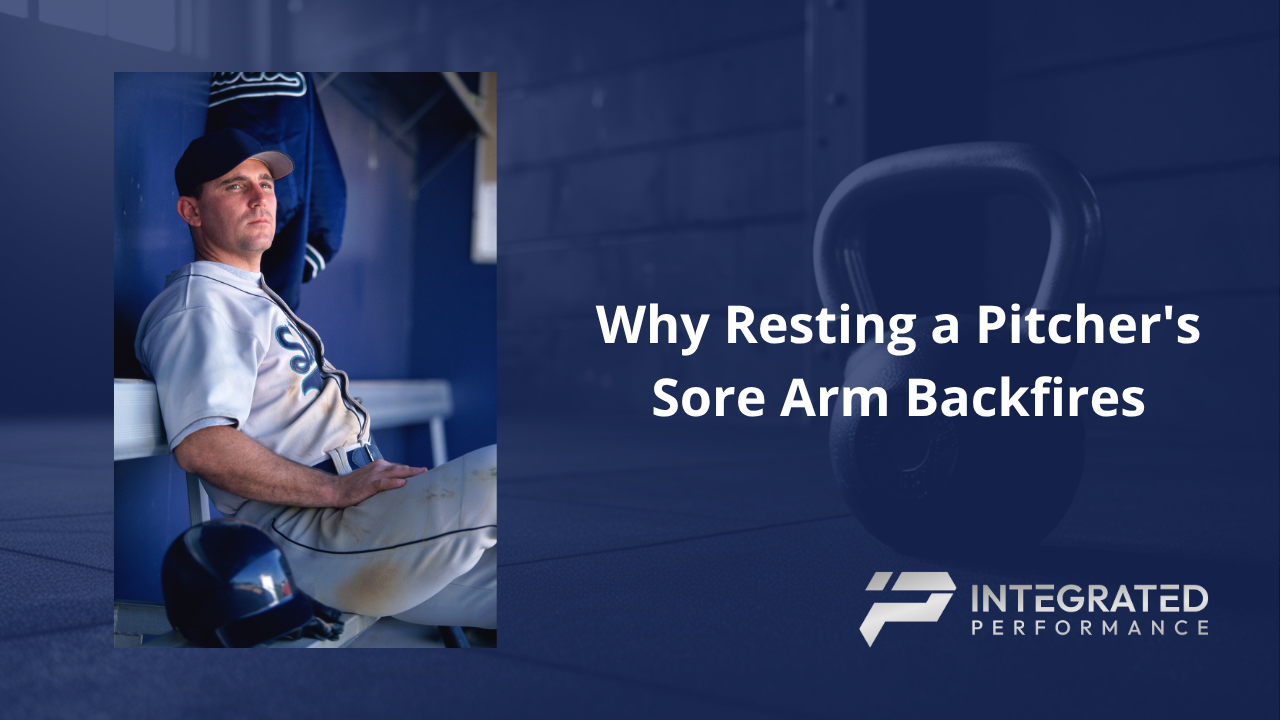
We have all lived this moment as baseball parents: your son walks off the mound at the end of the fall season, physically hanging on after throwing just two innings before sharp, biting pain flares up on the inside of his elbow. As a parent, you feel sick with worry that this setback will stall his development, cost him critical showcase reps, and derail his college recruiting timeline.
The natural instinct is to tell yourself: "If we just shut him down and let him rest until winter, the pain will go away and he will be totally fine for spring."
Unfortunately, sports medicine does not work that way. Passive rest alone will never fix an injured throwing arm, and counting on the calendar to heal your pitcher is not a plan for his arm health and his athletic future.
Is Complete Rest from Throwing the Best Way to Let an Arm Heal?
The short answer is absolutely not.
Pain is merely the alarm sounding off in his elbow; it is rarely the actual cause to why his pain his elbow is hurting in the first place. While excessive pitch counts certainly cause fatigue, joint and tendon breakdowns almost always stem from hidden deficits elsewhere—such as a weak rotator cuff, dynamic forearm stabilizer fatigue, or restricted lead hip mobility that creates massive mechanical inefficiencies.
Passive rest completely ignores the biological reality of damaged tissue. If your son strained his flexor-pronator tendon or suffered a sprain in his Ulnar Collateral Ligament (UCL), sitting and doing nothing for it will never rebuild tensile strength.
Tendons and ligaments require progressive, mechanical loading to stimulate cellular remodeling and properly align collagen fibers. When you shut him down completely without progressive loading, that tendon heals in a weak, disorganized, and deconditioned state. Pure rest just turns your off-season into a waiting game for the exact same injury to pop back up next spring.
Why Does His Arm Hurt Again the Moment He Picks Up a Baseball?
This is the single most frustrating scenario I see every single year in our clinic.
Parents wait six to eight weeks while their son rests, assuming time has cured the problem. The acute inflammatory response calms down from not throwing, but the moment he picks up a ball and throws past 60 feet, that sharp elbow pain flares right back up.
That pain returns because passive rest never addressed the root cause of the breakdown. If his dynamic rotator cuff stabilizers are weak, his shoulder cannot decelerate the arm, forcing the medial elbow to absorb extreme valgus torque.
Single-leg balance is another massive blind spot for throwers. Research shows that baseball players diagnosed with UCL tears demonstrate significantly decreased single-leg balance and dynamic stability compared to healthy teammates (Garrison et al., 2013). If your son cannot stabilize on one leg during his delivery, he creates a severe energy leak that forces his elbow to take the brunt of the throw.
If the Pain Is in His Elbow, Why Look at His Hips, Spine, and Scapula?
Throwing a baseball is a total-body movement where force flows from the ground, through the legs, across the core, and out through the fingertips.
When one link in that chain fails to move or stabilize, every joint down the line gets overloaded. Consider something as fundamental as your son's stride length.
A high school pitcher needs a stride length roughly equal to his full body height to generate momentum toward home plate. If he lacks posterior chain mobility or backside hip rotaiton, his lead foot plants into the ground prematurely.
When his lower half speeds up and lands early, his throwing arm gets dragged behind, forcing it to play catch-up to release the ball. That mechanical lag places increased valgus stress across the inner elbow and UCL.
To permanently resolve arm pain, you must treat the whole athlete. We respect biological healing at the injured joint, restore local tissue capacity, and then systematically fix the kinetic chain restrictions away from the site of pain so the injury never recurs.
Key Takeaways for Baseball Parents
- Rest Alone Is a Trap: Passive rest temporarily relieves symptoms, but it leaves tendons weak, unorganized, and prone to reinjury upon throwing.
- Tendons Need Progressive Load: Rebuilding collagen fiber alignment in the flexor tendon or UCL requires structured, criteria-based loading.
- Fix Energy Leaks: Weak rotator cuff stabilizers and poor single-leg balance leak energy directly into the medial elbow.
- Solve the Root Cause: Standard physical therapy treats the site of pain; precision performance rehab identifies and eliminates the biomechanical root cause.
Stop waiting for rest to fix your son's arm pain
Don't let an unaddressed post-season arm issue turn into a season-ending UCL tear or derail his college recruiting timeline. Book a Precision Off-Season Arm & Body Assessment at our clinic to find the true root cause and build a bulletproof arm before winter training begins.
Want to Make Sure You Do Not Miss a Post?
Enter your information for FREE newsletters, content, and special offers from Integrated Performance
We will not SPAM (unsub at any time)
